

 Inquire (

 HOME
How to Evaluate Mattress Quality Before Placing a Bulk Order
 Oct 31,2026

 Cloud Point
1. Why Pre-Order Quality Evaluation Matters for B2B Buyers
For B2B buyers, evaluating mattress quality before placing a bulk order is one of the most important steps in the sourcing process. A single approved sample may feel comfortable, but consistency across hundreds or thousands of units is what determines commercial success. Poor quality control can lead to guest complaints, higher return rates, brand damage, and unexpected replacement costs.
A professional mattress factory should be able to support buyers with clear specifications, approved samples, material documentation, and inspection procedures. For hotels, distributors, retailers, and private-label brands, the goal is not only to find a good mattress design, but to confirm that every production batch can meet the same standard.
2. Confirm Material Specifications Before Production
Mattress quality begins with materials. Comfort layers, support systems, covers, and packaging all affect durability, sleep feel, and safety. Buyers should request detailed specifications rather than relying only on product names or marketing descriptions.
Key material points to confirm include:
Foam density and ILD firmness for memory foam or polyfoam layers
Spring type, wire gauge, and coil count for pocket spring or innerspring models
Cover fabric weight, composition, and stretch performance
Edge support structure to prevent early sagging
Adhesive type and bonding process for layered constructions
Fire barrier materials required by the destination market
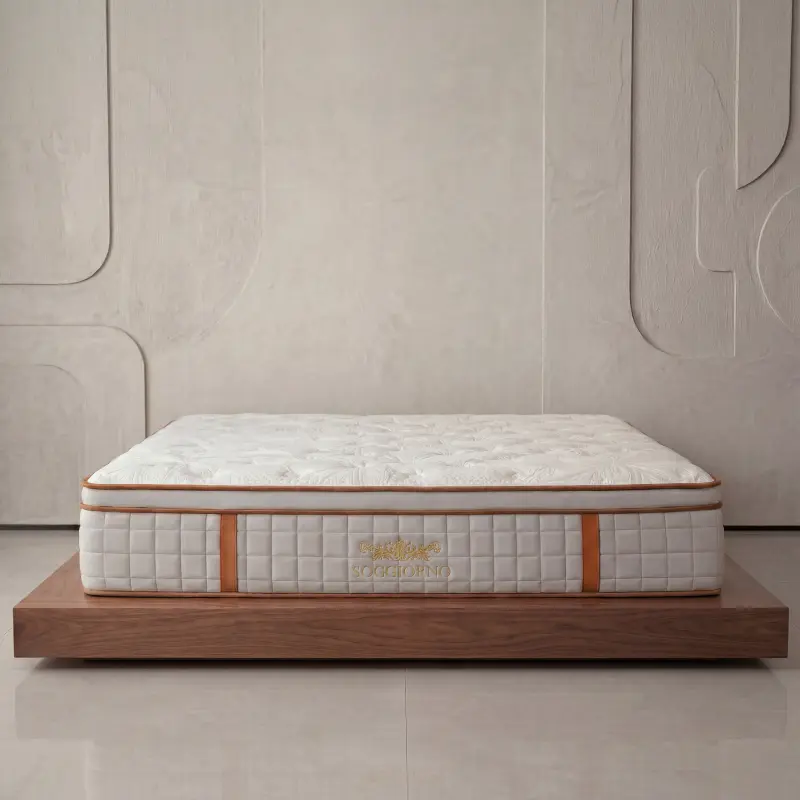
For hybrid mattress models, buyers should also check how foam layers and spring systems are combined. A well-balanced hybrid should provide both support and pressure relief without excessive softness that may reduce durability.
3. Review Approved Samples and Production Consistency
Sample approval is the foundation of bulk mattress quality. Buyers should evaluate at least one production-representative sample before confirming a large order. The sample should match the materials, dimensions, firmness, and packaging planned for mass production.
During sample review, buyers should check:
Height and dimensional accuracy
Firmness consistency across the sleeping surface
Edge support when sitting or sleeping near the perimeter
Noise level during movement
Cover stitching, zipper quality, and handle strength
Odor level after unpacking
For export orders, it is important to confirm that the sample represents normal production capability. A factory that can provide batch control records and material traceability offers stronger assurance for long-term cooperation.
4. Assess Durability and Commercial Use Performance
Durability is especially important for hotel projects, rental properties, and high-volume retail programs. A mattress that feels comfortable at first may still fail early if the materials are not suitable for frequent use.
Buyers should ask the factory about:
Expected service life under normal commercial use
Foam compression resistance and recovery performance
Spring system durability and motion isolation
Edge support retention after repeated use
Cover abrasion resistance and cleaning requirements
Warranty coverage and defect handling process
For hospitality buyers, durability evaluation should also consider housekeeping operations. A commercial mattress should withstand regular inspection, rotation, and cleaning without visible damage or performance loss.
5. Check Compliance, Safety, and Export Documentation
Quality evaluation is incomplete without compliance confirmation. Different markets have different requirements for fire safety, labeling, material safety, and environmental standards. Buyers should confirm all documentation before production begins.
Common compliance items include:
Fire safety certificates for the target country or region
Material safety declarations for foam and textile components
Labeling requirements for size, composition, and care instructions
Packaging markings for export shipping and warehouse handling
Third-party test reports when required by retailers or hotel chains
A reliable mattress manufacturer should provide clear documentation and explain which standards apply to each destination market. This helps buyers avoid customs delays, product rejection, or post-delivery compliance risks.
6. Plan Inspection, Packaging, and After-Sales Support
The final step is to confirm how quality will be maintained during production, shipping, and after delivery. Buyers should agree on inspection methods before the factory begins mass production.
Important arrangements include:
Pre-production sample confirmation
In-process quality checks during production
Final random inspection before shipment
Packaging protection for sea freight or long-distance transport
Spare unit planning for hotel or distribution projects
Defect reporting and replacement procedure
For roll-pack mattress orders, buyers should also confirm recovery instructions and minimum rest time after unpacking. For flat-pack or hotel-grade mattress orders, corner protection and moisture-resistant wrapping may be necessary to prevent transit damage.
7. Conclusion: Build Quality Confidence Before Committing to Volume
Evaluating mattress quality before a bulk order requires more than checking comfort. B2B buyers should review material specifications, approved samples, durability performance, compliance documentation, inspection procedures, and after-sales support. These steps help reduce risk and ensure that each delivered mattress meets the agreed standard.
Working with an experienced mattress factory allows buyers to move from simple product selection to structured quality management. When specifications, samples, and inspections are clearly defined, bulk mattress orders become more predictable, more efficient, and better aligned with long-term business goals.
 Memory Foam, Pocket Spring, or Hybrid: Which Mattress Type Fits Your B2B Market?
 You May Also Like













 Tel
 Email
 Address
NO.9 industry rd, Gegao, Longjiang, Shunde, Foshan,China